The Book of Job in the Old Testament has always been a source of fascination, especially for its insights into the mystery of human suffering and the trust in God that it demands.
A new contributor to The Defendant, Anthony Charles Smith, an author and retired barrister, draws on a famous short work of Chesterton’s to explore “the riddle of Job” – a riddle that reflects the characteristically human yearning for an explanation of life and its most challenging experiences such as suffering; a riddle that Job knows only God can unravel.
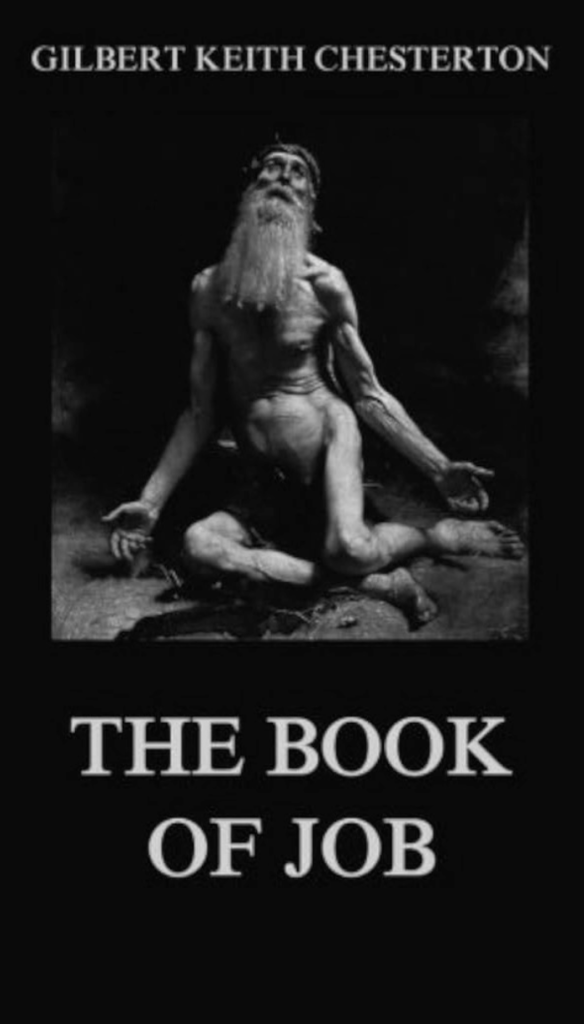
Chesterton’s masterful analysis of the Book of Job (first published as a long Introduction to Wellwood’s 1907 edition of the Old Testament text) invited study beyond
‘trying the patience of Job’ cliché. It opened a veritable sea change of belief.
When language like this, inter alia, is deployed – “My bone cleaveth to my skin and to my flesh, And I am escaped with the skin of my teeth (19:20) … My days are swifter than a weaver’s shuttle, and are spent without hope (7:6) … They that plow iniquity, and sow wickedness, reap the same … (4:8) – there can be no surprise that it inspired Chesterton.
Rejecting Mrs Job’s urgings to “curse God and die” was what stamped Job’s character throughout. Job knew that his Redeemer lived for him. In Chesterton’s words: “He remonstrates with his Maker because he is proud of his Maker. . . He is anxious to be convinced [because] he thinks that God could convince him.”
But, as Chesterton then notes, the Book of Job only “answers mystery with mystery” – and mystery begets revelation. As the Bible’s oldest Book, it is at its the most baffling when Job is pitchforked into abject suffering by Satan, yet opens a window into Almighty God.
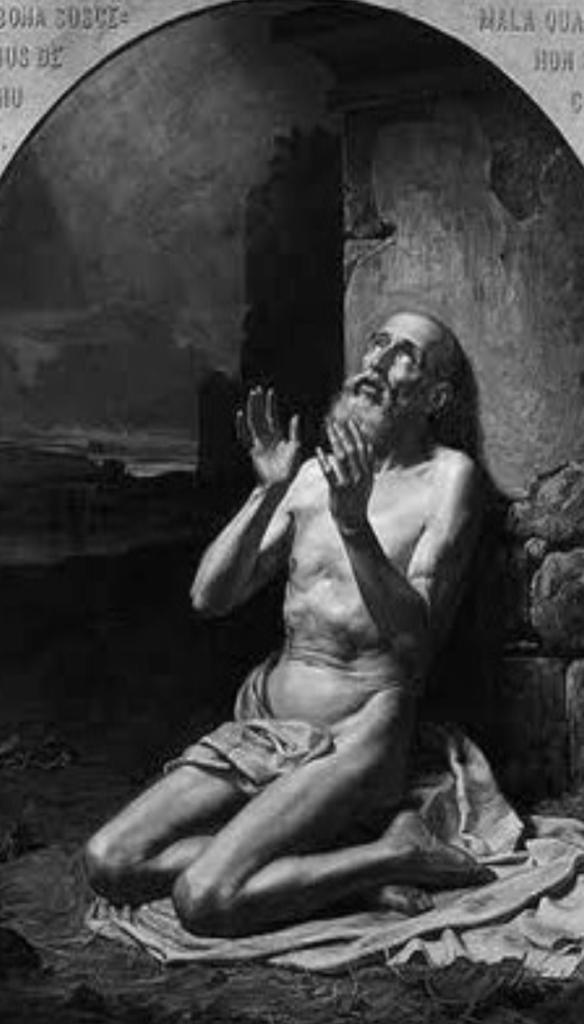
An upright, wealthy man living in the area now known as Kuwait, Job feared God and eschewed evil, then lost his children and his standing to wallow amidst a dung heap foraging for chards to scrape his sores. What was God doing? And as if his suffering wasn’t enough, Job’s friends, whom he labels “miserable comforters”, and with whom
he interacts for two thirds of the book, try to wrench unconfessed sin from him.
To the secularists, suffering – such as that caused by cataclysmic earthquakes, cyclones, and lightning strikes – provides another excuse to lambast God and those who believe in Him. These lead to some loss of life, but are necessary to the survival of billions.
The Book of Job makes references to lightning (cf.36:30-33; 37: 3-5; 38: 24-27, 35). Scientists declare that lightning contributes to nitrogen fixation, a nutrient for plants among other benefits. Cyclones increase chlorophyll concentrations along continental shelves bringing nourishment to many species. Winds lift huge quantities of sea-salt aerosols from the ocean, which play a critical role in raindrop formation.
Job reveals an expanding universe: “He alone stretches out the heavens” (cf.9:8). The Hebrew verb natah, translated as “stretches out”, implies an ongoing continuous expansion, expressed many thousands of years in advance of the astronomer Edwin Hubble’s 1929 discovery of distant galaxies moving away from the earth.
The literal shifting to the metaphorical
The challenge in examining the riddle recognised by Chesterton ever remains in determining when and how a passage shifts from the literal to the metaphorical. What doesn’t change in the Book is God’s consistent involvement in the realm. The Genesis writer had Job from which to draw, and consequently things already set down there need not be repeated in Chapters 1-11 of Genesis.
Thus, Job’s description of God’s creative work indicates the flood could not have been global. “Who shut up the sea behind doors when it burst forth from the womb … when I fixed limits for it and set its doors and bars in place, when I said, ‘This…is where your proud waves halt?’” (38:8, 10-11).
Psalm 104:6 echoed Job in that primordial earth was a water world, but that on day three, continents rose separating land masses, and that “never again” (ibid.104:9) would waters “cover the earth”. Noah’s flood occurred well after the third creation day.
Through Job we see that the flood was for the world of “ungodly people” (2 Peter 2:5), “of that time” (2 Peter 3:6), making a clear distinction between Noah’s world and the world of Peter’s time. Were the descendants of Job, his three friends and young Elihu, the brilliant scribe (chapters 32-37), part of that “ungodly world”?
In the lead-up to God’s appearing “out of a whirlwind” to “put Job in the dock”, Chesterton asserts that Job remonstrates with his Maker (31:35). Job speaks of the Almighty as his enemy, but he never doubts that his enemy has some kind of a case that Job himself does not understand.
From Chapter 38, Job is silenced. As Chesterton says, “It is one of the splendid strokes that God rebukes alike the man who accused [Job], and the men who defended Him.” He asks Job who he is. Job, being a man of candid intellect, takes a little time to consider, and comes to the conclusion that he does not know.
Job needed time to comprehend why he had to endure so much suffering, but he never wavered in his conviction that God could offer good reasons for subjecting him to torment and devastation.
Riddles of God more satisfying than solutions of man
Chesterton strikes a solid note with the observation that men of religious faith have philosophic doubt. Rather than answer riddles, Chesterton argues, God propounds them. His refusal to explain His design, “is itself a burning hint of His design. The riddles of God are more satisfying than the solutions of man. … God says, in effect, that if there is one fine thing about the world, as far as men are concerned, it is that it cannot be explained. He insists on the inexplicableness of everything; “Hath the rain a father?… Out of whose womb came the ice?” (38:28). He insists on the positive and palpable unreason of things; “Hast thou sent the rain upon the desert where no man is, and upon the wilderness wherein there is no man?” (38:26).
Chesterton adds: “Instead of proving to Job that it is an explicable world, [God] insists that it is a much stranger world than Job ever thought it was … He has contrived
to let fall … sudden and splendid suggestions that the secret of God is a bright and not a sad one – semi-accidental suggestions, like light seen for an instant through the crack of a closed door. . . this optimism breaking through agnosticism like fiery gold round the edges of a black cloud.”
Chesterton’s conclusion is striking: “For when once people have begun to believe that prosperity is the reward of virtue, their next calamity is obvious. If prosperity is regarded as the reward of virtue it will be regarded as the symptom of virtue.”
And from Darwin to Dawkins, how would they answer those questions? Would Dawkins hold up a computer and point to man’s brilliant mind, yet answer that from whence came the snow was the product of mindless, unguided processes?
So Job was given time to process the source of his suffering, and while undergoing it Job could say, presciently, of Christ, “For I know that my redeemer liveth, and that he shall stand at the latter day upon the earth…”(19.25) And God gave back ten more children and double his former possessions.
To Chesterton for the final word:
“But in the prologue, we see Job tormented not because he was the worst of men, but because he was the best. It is the lesson of the whole work that man is most comforted
by paradoxes.”
Indeed we are, while discovering hidden treasures in the Book of Job.