The public image of Chesterton as a man of geniality and generosity of heart may not prepare us for the discovery that he knew the world as also a place of pain and pounding.
The Argentinian writer Jorge Luis Borges saw in Chesterton dark depths and hints of diabolical awareness, and the English journalist Malcolm Muggeridge sensed that, beneath his manifest happiness and joyous wonder, Chesterton was also “an anguished, frightened spirit.”
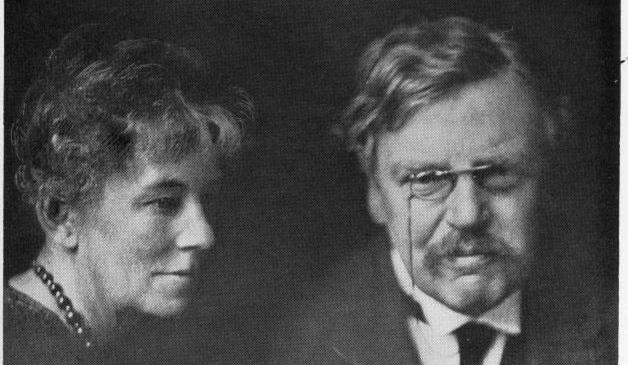
Such counter-balancing features gain more credibility when we reflect on the wounds that Chesterton suffered in his life – and the scars that he carried. While by his own admission he had an Gilbert and Frances Chesterton idyllically happy childhood, his adult experiences were more mixed, and they had the effect of deepening his understanding, which led to so many memorable insights.
He did not enter the Catholic Church until 1922, at the age of 48, but he was long aware of what he called “the morbid but vivid problems of the soul” to which he found the Catholic faith a spiritual solution. As he wrote in his autobiography in 1936:
That the Catholic Church knew more about
good than I did was easy to believe. That
she knew more about evil than I did seemed
incredible.
In an early essay, “The Diabolist” (published in Tremendous Trifles, 1909), Chesterton recalls a conversation he had with a stranger, which he describes as “by far the most terrible thing that has ever happened to me in my life.” The diabolist showed “a horrible fairness of the intellect that made me despair of his soul.” He embraced good and evil indiscriminately and, believing that evil had a life of its own, he pursued it as energetically as good.
This essay brings out powerfully Chesterton’s penetrating grasp of modern culture – marked by its abandonment of objective truth and reality, and its incapacity to see intellectual distinctions.
Symbolically, the conversation in “the Diabolist” took place near a bonfire which sent its red sparks into the air. After Chesterton heard these last words of the diabolist, he rushed away, and as he passed the fire he confessed that he “did not know whether it was hell or the furious love of God.”
The cross of childlessness
A major wound that Chesterton suffered was in his married life – what his first biographer Maisie Ward called “the heavy cross of childlessness”.
Despite a deeply happy marriage with Frances, constantly attested throughout their life together, they were not able to have children. This was a cross borne especially by Frances, and the themes of longing for a family can be found throughout her poetry – as in one poem where she (“though my arms be empty”) finds solace in the Blessed Virgin Mary cradling the “Eternal Child” and being touched “with a divine caress”.
The longing was also felt by Gilbert, who captured it poignantly in his poem, “By the Babe Unborn”, where he reflects on the darkness of the child in the womb and, in the final two lines, the yearning for birth: “If only I could find the door/If only I were born.”
Yet the Chestertons bore the pain of childlessness courageously. Stories abound of how warmly they connected with children – by holding, for example, a regular Christmas party in their Beaconsfield home to which only children were invited. Gilbert would dress as Santa Claus and engage with the children in their games, while Frances produced original plays for the children to perform.
The British diplomat Sir Alec Randall recalled that, during the Chestertons’ visit to Rome in 1929, they arranged a party for the diplomat’s children. Upon arriving to pick them up, he found Chesterton “sitting tilted back in a chair, with a large white towel tucked into his collar, being lathered and shaved with a pretended razor by my small son.”
Undoubtedly a special consolation was the support of Dorothy Collins as Gilbert’s secretary for the last ten years of his life. She was, as Aidan Mackey noted, the daughter the Chestertons could not have.
The loss of a brother
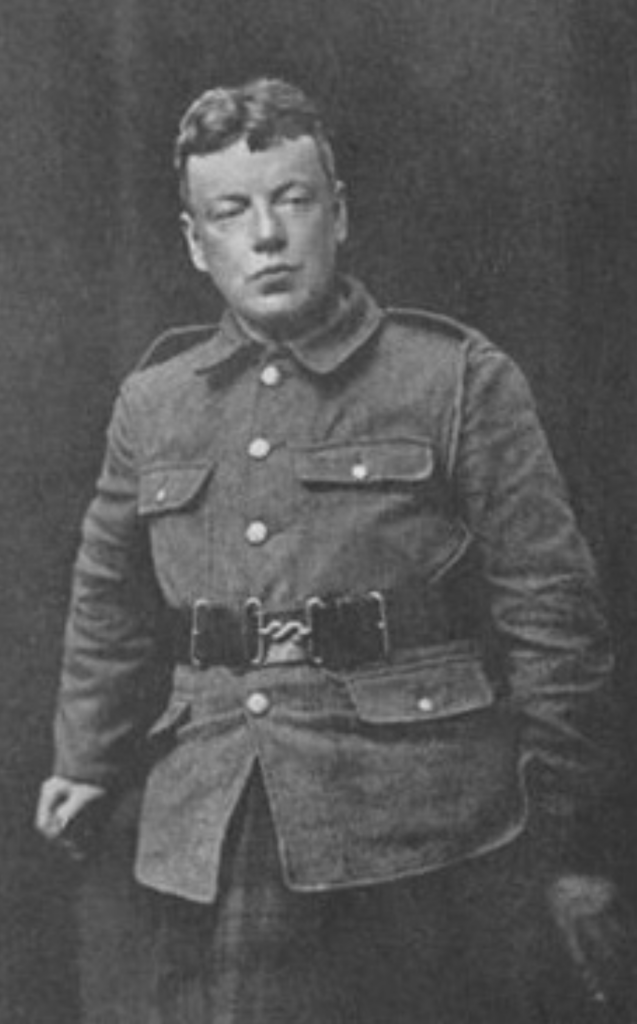
Chesterton suffered a double wound with the final years of his only brother, Cecil. A fellow journalist – though more pugnacious and polemical than Gilbert – Cecil was convicted of libel for exposing political corruption (in an insider trading scandal involving the Marconi brothers and various British politicians at the time). Subsequently Cecil died at the close of the First World War, after being wounded on active service in France.
Gilbert recalled the turbulent warmth of their brotherly relationship – how they “perpetually argued, but never quarrelled.” He saw a fundamental difference now obscured – that an argument is about objective truth and evidence, while a quarrel is about personal character and behaviour. As Gilbert put it: “the principal objection to a quarrel is that it interrupts an argument.” (Autobiography, 1936)
Cecil’s early death led to Gilbert taking on the editorship of his weekly journal The New Witness, which under the changed name of G.K.’s Weekly honoured Cecil’s legacy by continuing to promote Distributism as a philosophy of widely distributed rather than centralised ownership and power.
When Gilbert came to reflect on the deep wound that Cecil’s early loss represented for him, he simply noted:
“A portrait is impossible; as a friend he is too near me, and as a hero too far away.”
Chesterton suffered other wounds in his life, especially the physical breakdown he experienced in 1914 as a result of overwork, but the enduring impression is of his bravery in surmounting the trials he faced, and allowing them to deepen his understanding – and enrich the works he has left us.