What would Chesterton have made of Artificial Intelligence (AI)?
We can only speculate at this distance from his life, but he left at least two sources of guidance as to how he might have viewed AI. The first is his own writings about the machine age and the early implications of technological development. The second is his characteristic insights, in particular his sense of paradox as a way of balancing truths that are in tension – and thereby are more revealing of reality.
These intellectual legacies – Chesterton’s insights into automation and his penetration of reality through paradoxes – may help us to evaluate the promise, and the peril, of the AI revolution.
Artificial vs human intelligence
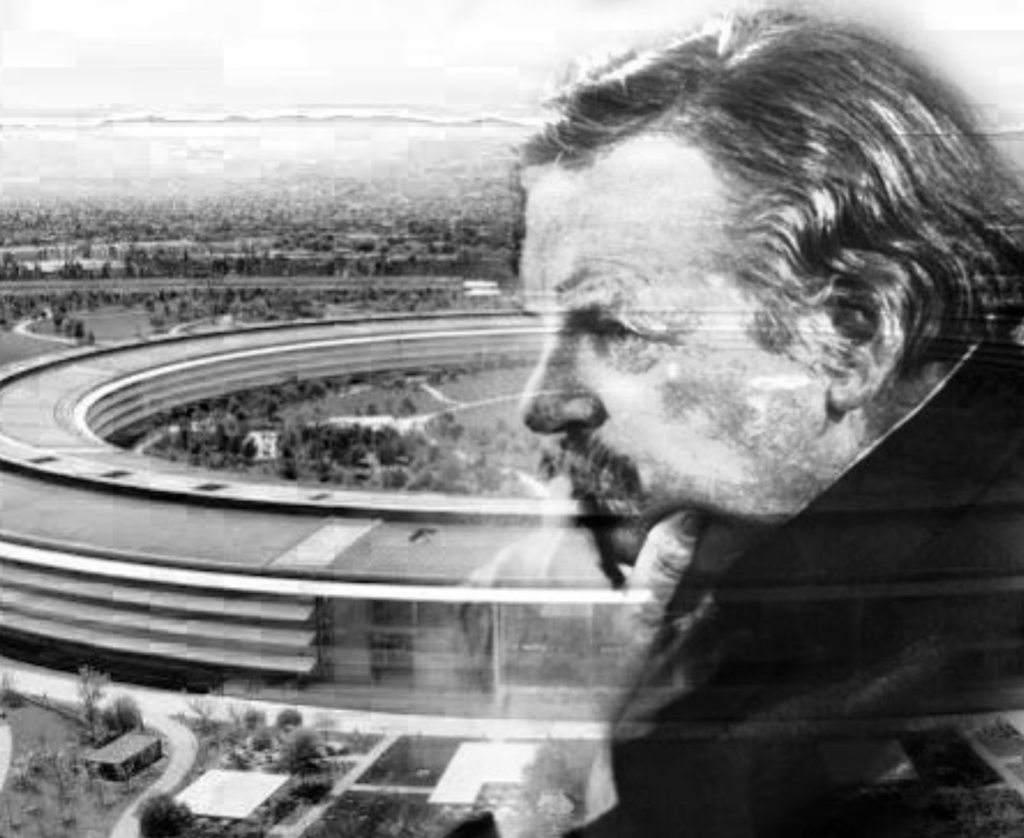
Chesterton’s first reaction to AI might have been to wonder at the very idea of “artificial intelligence”. How could the workings of the human mind and imagination be construed as “artificial” – contrived, not real, and blind to the natural wonder of creation.
This might have been heightened when he found that AI relied on such a distinctively human quality as language. (He may even have joked that, while AI is powered by Large Language Models (LLMs), he himself was a Large Language Model!)
The practical effect of construing intelligence as “artificial” could be what Chesterton saw was the silent effect of machinery – that it can make us think and act like machines, so that it controls us rather than serves us. We can fall into a mechanistic mindset, not fully rounded and responsive to the richness of human nature, and be tempted to evaluate human beings as if they were machines.
In The Outline of Sanity (1927), in a chapter aptly called “The Wheel of Fate”, Chesterton argued: “Before we begin any talk of the practical problem of machinery, it is necessary to leave off thinking like machines.”
Chesterton himself disdained any Luddite rejection of machinery. But he realised, even at this early stage, a curious trend – how quickly the initial wonder of a technological advance wears off, and we simply take it for granted as part of ordinary experience. In an essay on the telephone, Chesterton highlighted this risk:
“There has certainly been a rush of discovery, a rapid series of inventions; and, in one sense, the activity is marvellous … But it has been a rapidity in things going stale; a rush downhill to the flat and dreary world of the prosaic; a haste of marvellous things to lose their marvellous character.”
As I Was Saying, 1936
Resisting the technological imperative
Apart from dulling our sense of wonder, Chesterton was also concerned that the machine age could have a deeper and more insidious impact – that it might nurture an attitude of subservience which could easily lead, as we see in our pervasively technological age, to what has been called the “technological imperative” – that “if it can be done, it has to be done”, as though every technological advance spells progress.
Chesterton resisted the “technological imperative” by placing it in a wider humanist context:
“There is no obligation on us to be richer, or busier, or more efficient, or more productive, or more progressive, or in any way worldlier or wealthier, if it does not make us happier.”
“The Wheel of Fate”
Even the AI industry is now beginning to echo Chesterton’s words of caution. The American company, Anthropic, a driving force in California’s Silicon Valley, has recently called for a global pause in AI development. Its leaders warn of “humans losing control over AI systems”, and of the speed with which AI capabilities will “eclipse those of humans.”
Certainly the early impact of AI is being felt in various fields. One is commerce, where the economic promise of increased productivity is offset by the social impact of job dislocations and depersonalised services. Another is education, where it provides easier access to the accumulated record of the past, but is also generating concerns that it favours superficial learning and facilitates academic cheating.
Concentration vs dispersal of power
Probably the deeper worry is the concentration of economic and political power that Chesterton long fought against. In his time, such power lay with the conglomerates of private industry (including in his own sphere of journalism with the control exercised by a handful of press barons), and was also unmistakable in the political sphere – in the encroaching structures of the state.
In our time, it has extended to the new technology, dominated as it is by a few massive companies such as Microsoft and Apple, and by individuals like Bill Gates and Elon Musk.
In his recent encyclical on AI, Magnifica Humanitas, Pope Leo XIV invokes the Catholic social principle of subsidiarity, so beloved by Chesterton, to warn against this concentration of digital power (pars.68-72). The pope affirms the crucial need for technological power to be spread as widely as possible, across regions and organisations, so that human dignity is respected and social accessibility guaranteed.
The search for ultimate meaning
Yet the likely disruptions of AI may have a compensating (if painful) benefit of enlivening us to the spiritual emptiness of contemporary culture. We are conditioned to see technology as an answer to all problems, even when we realise that it focuses on the “how” questions (how things came to be and how they work) rather than the “why” questions (why things exist at all, what they mean and why they matter).
Technology cannot finally quench the thirst for ultimate meaning and purpose that religious faith previously supplied.

A leading figure at Anthropic, Avital Balwit, has drawn on Chesterton’s power of paradox to shed light on the spiritual challenge of AI. Impressed by Chesterton’s belief (as expressed in a chapter in Orthodoxy, “The Paradoxes of Christianity”) that we should feel “at once astonished at the world and yet at home in it,” she notes our contrasting condition – that now “we are neither astonished at the world nor at home in it.” (“Searching for God in Silicon Valley”).
Balwit’s lament echoes Chesterton’s regret about the machine age – that we rapidly lose our sense of wonder at the marvel of new inventions, and find it hard to feel satisfied by the benefits they provide.
Closely connected – but lonely
A striking paradox of present-day culture, to which Chesterton would have been alive, is that the most connected generation in history – Gen Z, those in their mid-teens to late twenties – is also the loneliest. As noted by the American author, Presley Shumate (in “The Conservator,” May 2026), the craving for connection can give rise to screen-based interaction being taken for friendship, and disembodied closeness for commitment.
In the new age of AI, Balwit focuses on religious faith as a time-honoured way of recapturing the experience of wonder and welcome. As she writes:
“You cannot stand this close to questions of omniscience and immortality without being pulled toward the territory religion has always occupied.”
When Chesterton surveyed the main systems of concentrated power in his time, capitalism and socialism, he commented: “You have left certain human needs out of your books. You may leave them out of your republic.” Might he have offered a similar reaction to the concentration of technological power in our time? –
You have left certain human needs out of your AI scenarios. You may leave them out of your AI design of society.