
The President of the Society of Gilbert Keith Chesterton in America, Dale Ahlquist, has produced a most unusual book, creating a second autobiography of Chesterton based on his own writings, which in some ways is more revealing than his own Autobiography (1936).
Gary Furnell reviews this work, entitled I Also Had My Hour: An Alternative Autobiography by G.K. Chesterton (Ignatius Press, 2025). His review first appeared in the current affairs magazine, News Weekly (January 15, 2026), and is republished with the kind permission of its Editor, Peter Kelleher.
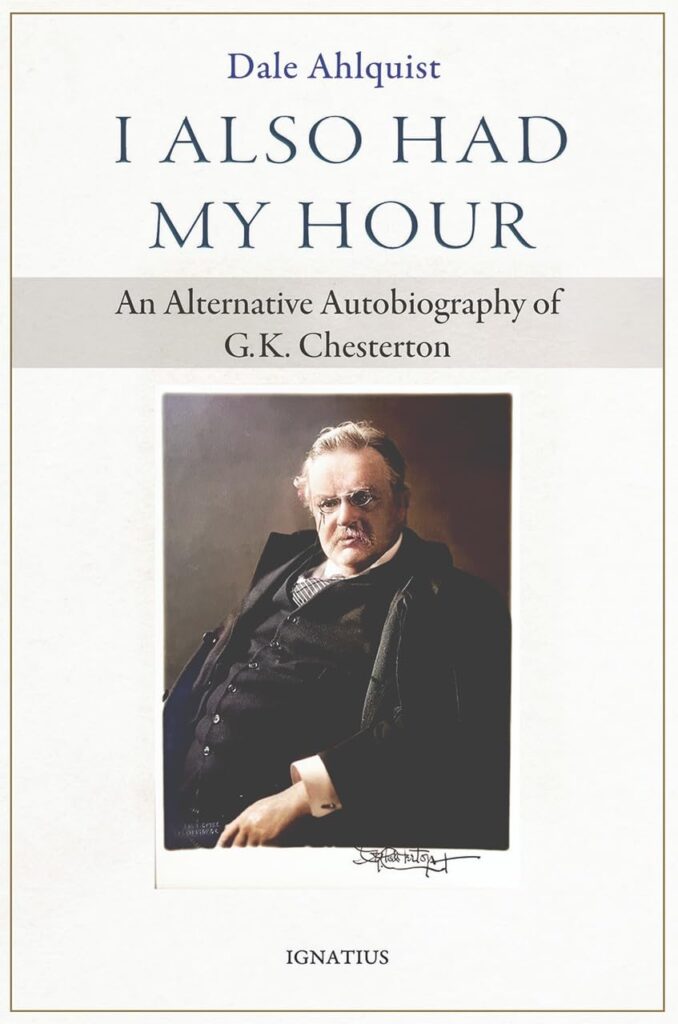
Autobiography by G.K. Chesterton (Ignatius Press, 2025)
This is an intriguing book with, perhaps, no precedent in its concept. Dale Ahlquist has sought to construct a type of new autobiography by compiling what Chesterton wrote or said about his life and views.
Ahlquist wanted Chesterton to tell us more about himself because the autobiography that Chesterton wrote, published after his death in 1936, left out a great deal. Somehow, he neglected to reveal much about his life in his autobiography.
The contrast between Chesterton’s 1936 autobiography and Ahlquist’s alternative 2025 version underscores this intention:
“He managed to insert a few details about Gilbert Chesterton, but not enough to paint a self-portrait. However, in his boundless writings about everything else, especially in his vast and largely uncollected journalism, he leaves fragments of an autobiography. I have tried to cobble together from this mountain of words a new version of Chesterton’s life.”
Ahlquist uses lines from Chesterton’s Easter poem, The Donkey, as chapter headings.
When fishes flew and forests walked
And figs grew upon thorn,
Some moment when the moon was blood
Then surely I was born.

With monstrous head and sickening cry
And ears like errant wings,
The devil’s walking parody
Of all four-footed things.

The tattered outlaw of the earth,
Of ancient crooked will;
Starve, scourge, deride me: I am dumb,
I keep my secret still.

Fools! For I also had my hour;
One far fierce hour and sweet:
There was a shout about my ears,
And palms before my feet.
Ahlquist’s method involved great and prolonged labour, but he says that it was a labour of love. For decades, in the musty years before the internet, he journeyed across continents, visiting libraries, dusty archives and overlooked offices to collect Chesterton’s neglected written work, principally his journalism. The result is a treasure trove that contributes sparkling insights into Chesterton and his epoch; it’s like the Sutton Hoo of early 20th-century philosophy.
Ahlquist used this recovered material for his alternative autobiography, combining hundreds of excerpts to provide a fresh perspective on Chesterton. At the bottom of each page, reference numbers identify the source and the year of each passage. There are also numerous footnotes that provide further context or offer additional editorial commentary. The subtlety is deliberate, adding valuable information without intruding on Chesterton’s account.
Previous biographies have tended to overlook Chesterton’s journalism and his speeches. This is ironic because Chesterton was a joyful journalist and, for more than 30 years, he was a dedicated speaker. No wonder he was famous. From 1903 to 1936, he spoke at clubs, openings of something or other, town hall meetings, church congresses, or college and university gatherings up to three times a week.
His efforts were prodigious, matching people’s eagerness to hear his insights. He wanted to encourage discussion of his ideas and expose the inept ideas tormenting society. He wrote in 1926:
“I believe more and more that the modern world has far too little argument of the real sort; and that the aim of any public-spirited person today must be to find a stable statement of truth, upon which alone anything socially solid can be built. When I look back on my life, even in the lightest fashion, I can see it only as an attempt to reach such an end.”
Detailed timeline of Chesterton’s life
Augmenting the unusual but effective narrative, Ahlquist provides a 112-page timeline, noting the main events of each month in every year of Chesterton’s life. This is a revelation of fascinating detail.
By 1902, when Chesterton was 28 years old, the pattern of his life – daily journalism and frequent speaking engagements – was decided. After the 1914-18 war, his engagements increased, culminating in his two visits to America with months of travel and dozens of lectures. While Chesterton’s intellectual abilities are often acknowledged, this timeline highlights his enormous energy, from his 20s to his 50s, given unstintingly to public good.
The “new version” autobiography – and the timeline – fill about one half of the book’s 477 pages. There is a vast reservoir of aperçus worthy of quotation – for example:
On state censorship: “It is wicked to nationalise mines or railroads, but we lose no time nationalising tongues and talk.”
On technology invading our lives: “We have given ourselves over to an insatiable monster who serves us at the price of our liberty.”
On Capitalism: “Capitalism does always begin with what is normal; with private property and political liberty. Owing to greed of property in some and neglect of liberty for all, it becomes mere plutocracy.” There are a multitude of shrewd observations to ponder.
Chapters are dedicated to more controversial aspects of Chesterton’s life and thought, including his friendship with Hilaire Belloc; Chesterton’s response to charges that he was hostile to Jews; the presence of evil; and duels with his critics.
There is a selection of Chesterton’s poems, revealing his concerns and hopes. It is appropriate to use his poetry to complement his prose because Chesterton set high value on poetry – it uses words to convey what is beyond words, proceeding from the heart.
Fifty-nine testimonies – arranged chronologically – from Chesterton’s colleagues, associates and friends provide further insights into Chesterton’s qualities, idiosyncrasies and achievements.
It is remarkable how quickly Chesterton matured, and how consistent he was once he matured. He was, early in his adulthood, friendly, humorous, intelligent, generous and keen to engage with people. He remained this way until his final sickness, although, as Ahlquist notes in his introduction, the bright, outward-bound energy of Chesterton’s youth gave way to quiet, sometimes solemn, reflection in his 50s and 60s.
He acknowledged this change, writing in his 50s: “I know that since my own views have grown much more settled and secure, I am less inclined than I was to go about incessantly contradicting everybody who contradicts them … And this is not because I am drawn towards thinking they are right, but because I am far more securely and serenely certain they are wrong.”
Chesterton wrote about his interior pilgrimage, leading to his conversion to Catholicism, “the chief event of my life”. Here, Chesterton’s facility with profound concepts and spiritual matters is displayed. Many of his fans delight especially in his religious writing, valuing his honesty, fairness, historical sense, Bible knowledge, his turn of phrase and his wit. Those fans now have a new wealth of Chesterton writing to pore over, cherish and memorise.
Fortunately, the book is a high-quality, durable item. It will last a lifetime of reading and thumbing through looking for treasured quotes. Alas, there are no photographs, although it is likely that Ahlquist unearthed many photographs of Chesterton in various settings at different stages of life.
We can be thankful to Dale Ahlquist for his decades of diligent work and his generosity in sharing the rich results in the form of an autobiography. Chesterton admirers, and those not yet admirers, will read keenly I Also Had My Hour.
In the decades ahead, no doubt there will be more Chesterton biographies written, but the authors will draw deeply – and, one hopes, with gratitude – on the incredible recovered resources compiled here. As always when reviewing a book, I read it twice. The time spent was enjoyable and profitable.
Chesterton once identified sloth as his besetting sin. We must take him at his word – he’s a better judge of his heart than we are – but it’s hard to reconcile sloth with the
hundreds of speeches, astonishing number of articles and dozens of books he completed.
Chesterton’s sloth makes other writers look comatose.