A perceptive review by the English writer Peter Ackroyd of a biography of Chesterton has prompted one of our Chesterton Society members to reflect on Chesterton’s enduring qualities, and why he continues to attract readers.
Chris Rule has a professional background in the Commonwealth Public Service and school librarianship. He previously contributed to The Defendant (Summer, 2024) on the extensive Chesterton Collection available at the London campus of the University of Notre Dame.
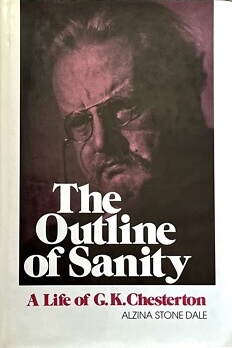
Alzina Stone Dale is author of The Outline of Sanity: A Biography of G.K. Chesterton (1982). The title is taken from Chesterton’s book, The Outline of Sanity (1926), in which Chesterton explained what ‘distributism’ is.
Peter Ackroyd reviewed Dale’s biography for The Spectator (8 May 1983), and I came upon the review in a book titled Peter Ackroyd: The Collection (2001), edited by Thomas Wright.
Ackroyd argues that Dale “has written a sober and most convincing study of Chesterton as a child – or, rather, orphan – of his age whose arguments in favour of familial responsibility and private liberty were intended as a challenge to the collectivist tendencies of the time and whose hard-won faith was based upon the intellectual merits of Christianity and opposed to the socialism or bogus humanitarianism of his contemporaries.”
The value of Ackroyd’s review, apart from its positive attitude towards Dale’s book, is that it draws attention to those factors which attract Chestertonians to Chesterton and his writings.
These factors include: he was not afraid to question the “conventional wisdom” of the age. Because of this he was called a “romantic” or a “reactionary”, insults usually thrown at those who didn’t support the intellectual fashions of the time.
He did not take himself seriously. As a consequence of this, he was not taken seriously by others.
His ability to see paradox was second to none. As Ackroyd points out: “The appropriate response to confusion is laughter, just as the only remedy for earnest but empty-headed orthodoxy is paradox.”
According to Ackroyd there was an “air of buffoonery” and “heartiness” about Chesterton. This disguised “great strength of intellect and a man who stood in fear of this God”. It also concealed “a most hard-headed man.”
He was a religious man whose faith was “hard-won”. He was an agnostic who became an Anglican, due to his wife. He eventually moved from Anglicanism to Catholicism in 1922.
He was a writer who became a journalist and author of books. At one time he worked for an occult publisher. It was when he began writing for the Speaker and the Daily News that he established himself as a journalist. According to Ackroyd he called himself a journalist and he was a journalist of “genius” who “scattered it in all directions.” By writing books he “set the tone of his whole life”.
Extraordinary things in an ordinary way
Amongst those who admired his writing talent were: Franz Kafka who admired his allegorical novels; T.S. Eliot and W.H. Auden who both praised him; Etienne Gilson, a Thomist theologian, who was so impressed with his book on Thomas Aquinas that he said “it made him despair” given it was based on “the most modest research.” Chesterton had a “large popular following” which, Ackroyd said, was based on his ability to say “the most extraordinary things in an ordinary way”.
Ackroyd concludes as follow: “And so we have a figure as paradoxical as any of his own epigrams or insights. A jolly, sensible Englishman who found sanctuary in the Roman communion; a good-humoured and equable man who in his Father Brown stories is obsessed by the nature of guilt and of sin; a man who could do nothing else but write and who damned his own writing with no praise at all.
“Now that his assaults upon ‘collectivism’ and the bureaucratic state seem to have some contemporary relevance, however, perhaps he will enjoy a revival. Alzina Dale has written a biography in which the imaginative and intellectual stature of the man is seen in full measure. Despite his own best efforts, he runs the risk of being taken seriously.”
Given Ackroyd’s words of praise for Dale’s biography, I would recommend it as an addition to the libraries of all Chestertonians.