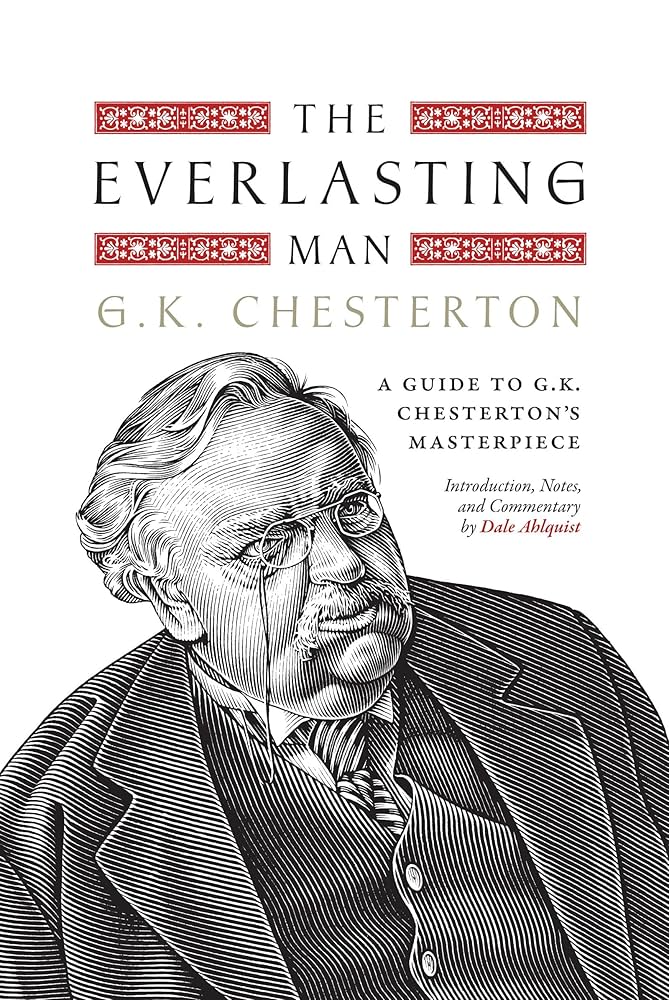
Garry Nieuwkamp, a frequent contributor to The Defendant, reviews the latest edition of Chesterton’s classic, The Everlasting Man (published by Word on Fire, 2023), which contains explanatory notes and extensive commentary on each chapter by Dale Ahlquist, President of the Society of Gilbert Keith Chesterton.
The year 1922 was a standout year in publishing. Ulysses by James Joyce was despatched to the public from a little bookstore on the left bank of the Seine, while, during that year, members of the Bloomsbury group were enjoying a weekend retreat listening to the first recital of T.S. Eliot’s The Waste Land.
1922 is also the year in which H G Wells published A Short History of the World, which caught the attention of our friend, Gilbert Keith Chesterton. (Incidentally 1922 was also the year that Marcel Proust entered eternal life, and that Chesterton entered the Universal Church.)
Three years later, in 1925, The Great Gatsby was published, the Locarno Treaties were signed, Virginia Woolf’s novel, Mrs Dalloway, and T.S. Eliot’s poem, The Hollow Men, were making their way to the printing presses, and George Bernard Shaw was getting the nod from the Nobel Committee.
And in 1925, Chesterton responded to H.G. Wells with what some regard as Chesterton’s greatest book, The Everlasting Man.
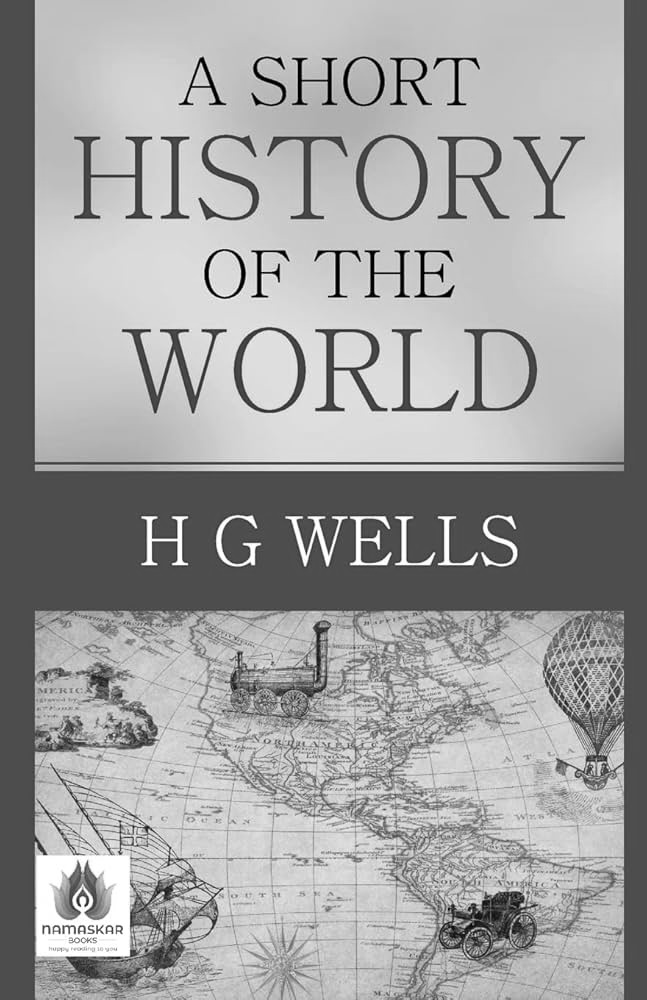
A Short History of the World, an abridged version of his Outline of History (1920), was an ambitious project. In ca.350 pages we pass through the age of coal swamps, monkeys, apes and sub-men, nomadic peoples and the first
sea-going peoples. We encounter the splendour of Greece, the life of Gautama Buddha, the teaching of Jesus, and on and on through to Mohammad and Islam and the dynasties of Suy and Tang in China.
Before long we are reflecting on the development of material knowledge, the Industrial Revolution, the American War of Independence and the French Revolution. And soon after that, we are in the trenches of the Great War with “the monstrous anger of the guns.” Breathtaking in its scope, as the blurb on the back of Wells’ book says.
But not all of this steady accumulation of facts sits well with Chesterton. Wells wrote a wonderful book, passionate in its intensity but he attempted to pray a lie. The Everlasting Man is a corrective.
Reading the book, and perhaps Chesterton more generally, can be both exhilarating and frustrating. Bill Clinton once said that you campaign in poetry and govern in prose. The one requires “footwork and firework”, the other attention to detail.
These two aspects in Chesterton are in constant tension. The poet is ever present, even when what is needed is the unadorned prose of apologetics. Evelyn Waugh is reputed to have expressed the desire to rewrite The Everlasting Man so as to eliminate what he regarded as Chesterton’s stylistic exuberance – his linguistic pirouettes and pliés.
One can easily sympathize with Waugh. But thankfully there is a new edition of The Everlasting Man recently published, annotated by Dale Ahlquist, which helps to deconstruct the lexical fouettés and frappés. Ahlquist speaks fluent Chesterton, and so provides the reader with two ways of reading The Everlasting Man; reading each chapter by Chesterton first, followed by the commentary by Ahlquist, or the other way around – through the eye of the needle or through the open gate?
This latest edition of the book is published by the Catholic media organisation, Word on Fire, started by Bishop Robert Barron to take advantage of the new digital platforms. The first thing that can be said about this latest edition is that the book is beautifully constructed, which is in keeping with their mission statement of harnessing truth, beauty and goodness to draw people into, or back to, the Catholic faith. Bookmark ribbons are both beautiful and practical.
But despite this new edition, the contemporary reader is still at a disadvantage. It is one thing to negotiate one’s way through Chesterton’s expressive exuberance, it is quite another thing to familiarize oneself with the vast reading habits of Chesterton’s contemporaries.
The reading public of the 1920’s had little distraction from other forms of entertainment that were later to become readily available, so the reading of newspapers, magazines, weeklies, and pamphlets was the entertainment. The criticism, for example, that Chesterton’s poetry was overly influenced by reading too much Swinburne, would make sense to an Edwardian audience, but go largely unnoticed by a contemporary audience, distracted by binge watching Criminal Minds and scrolling through interminable cat videos on TikTok.
These contextual elements in Chesterton’s writing present the reader with a challenge that an annotated copy of The Everlasting Man can help overcome but not eliminate.
Notwithstanding these elements, Chesterton has distilled into this book a lifetime of concerns in responding to Wells. It is clear to Chesterton that “The world is charged with the grandeur of God”.
“Shall I tell you the secret of the whole world?” he has Syme ask in The Man Who Was Thursday. “We see everything from behind, and it looks brutal. That is not a tree, but the back of a tree. That is not a cloud, but the back of a cloud. Cannot you see that everything is stooping and hiding a face?”
For the materialist like Wells, there is only the back of things; there is no “in front”. Consequently, when he tells the story of mankind, he leaves much unsaid. Ronald Knox has said of Chesterton that there was a boyish strain in him, as of one who has never got over reading Treasure Island. It is true.
The adventure among the facts
What is missing in Wells is the adventure that Chesterton sees lurking among the facts and events of history that are “stooping and hiding a face”. There is human progress certainly, as Wells has enthusiastically documented, but it is no accident that both authors are writing after the carnage and unprecedented slaughter of the trenches of World War I, “The hell where youth and laughter go”. Chesterton has been in Plato’s cave and has turned to see the light.
Within that history of mankind, religion for Wells is just another station on the Hegelian arc towards perfection. As Bishop Robert Barron has noted, Muhammad dies in his bed. The Buddha full of years dies surrounded by his disciples. Confucius the same thing. Moses dies at a ripe old age.
And then there is Jesus. He dies 33 years old, naked, pinned to a desperate instrument of torture, betrayed and denied, his disciples having abandoned him, his enemies mocking him. Jesus is a sign of contradiction.
Full religion is the large poem in loving repetition;
Les Murray, Poetry and Religion
like any poem, it must be inexhaustible and complete
with turns where we ask Now why did the poet do that?
Wells doesn’t ask – but Chesterton does, and sees it clearly: “that the midst of the earth is a raging mirth / and the heart of the earth a star” (Chesterton, “A Child of the Snows”). As Ronald Knox has noted, Chesterton was [and so was Les Murray] an artist in thought. He sees the paradox at the heart of Christianity. He sees the “poetry of the cross”. There are no creeds to Neptune and Aphrodite, but a symbol of torture sustains the martyrs as they utter credo – I believe.
If you reduce the supernatural to the natural, you get Christianity as just another story, just another event in the Short History of the World.
Chesterton sees a chasm between mythology and religion and between God and the gods. Jesus is not just another story in the ever-evolving trajectory of mankind. He is the author of the story, and so the main task of The Everlasting Man is to “quicken his readers’ perceptiveness”, to use John Holloway’s expression, so that the texture of the whole book becomes an experience of the divine for the reader, a source of wonder and truth, beauty and goodness.
God is, in Les Murray’s words, “in the world as poetry / is in the poem,” an insight that Wells missed entirely. You can’t pray a lie. The Everlasting Man is a reminder of that.